
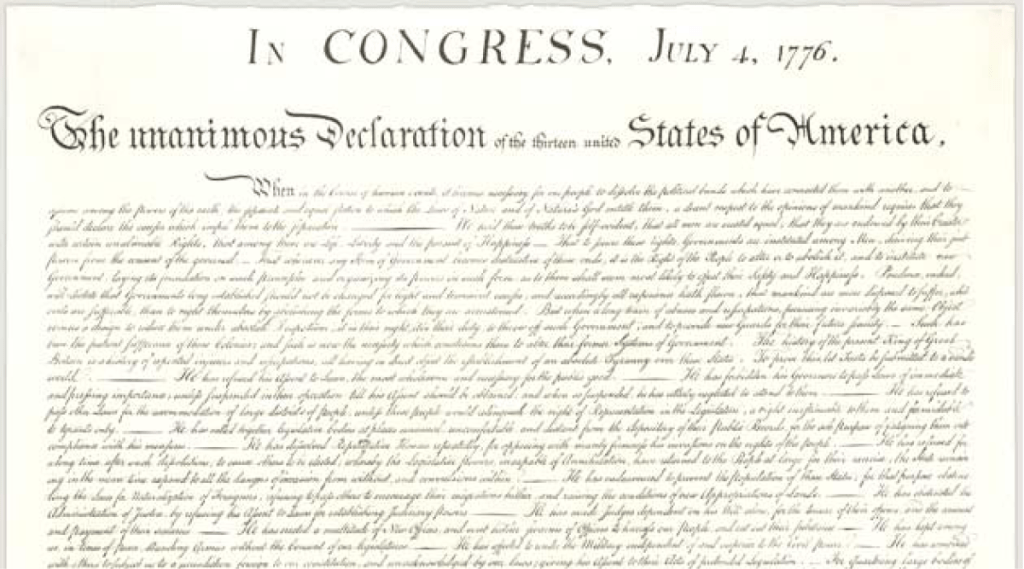
This year we celebrate 250 years since America’s founders declared independence from a distant, abusive empire to the east. West Coast states are in a similar position today. Let’s use the occasion of our semiquincentennial to consider all our options.
I’ve been writing about how we seem to be an irreparably divided nation. With increasing red-blue polarization, there is nothing united about these so-called United States. When in a relationship of irreconcilable differences, the healthiest thing do to is to separate. Like in 1776.
But not exactly like 1776, which was a drawn out, bloody conflict. And not like the Civil War of the 1860s. Those are the conflicts people first think of when they think of declaring independence. But that doesn’t have to be how we do things in the 21st century. We have other models now that involve much less violence.
One method is simply to pursue what some call “soft secession”—various “blue” states asserting greater independence within the existing US legal framework. All the methods of asserting state independence via soft secession are the first steps in whatever independence agenda we might favor. It’s a good direction to follow.
For those who might favor a harder secession, I’ve noted elsewhere that an independent “Pacifica” (Washington, Oregon, California, & Hawaii) would have the third largest economy in the world, and a higher per capita income than almost any other nation. That gives us great potential in a future world, but also gives us much leverage in the current world.
Many feel at the mercy of a hostile federal government that invades our cities and withholds federal funds we legally are entitled to, as if our only option is to beg for mercy from our abusive overlords or hope that they are stopped by a legal system mostly captured by the very regime we are opposing.
In this historic moment, we need to consider all our options. Including simply walking away from an abusive, toxic relationship. That’s a big step, not to be undertaken lightly. But when the price of remaining connected is increasing by the day, it needs to be an option on our menu.
As the Declaration of Independence famously asserts, when government becomes destructive to basic democratic values, “it is the Right of the People to alter or to abolish it, and to institute new Government, laying its foundation on such principles and organizing its powers in such form, as to them shall seem most likely to effect their Safety and Happiness.”
The Declaration lists “a long train of abuses” reducing people to “absolute despotism” and asserts the right and duty to throw off such government. These abuses include many that are familiar today, such as quartering troops among our communities without local consent, and protecting such troops from legal consequences of their actions. Meanwhile, others in the community are deprived of due process.
We could easily list a “long train of abuses” we face in blue states today for appearing to the despot to be insufficiently loyal and obedient. These would be just as serious as the grievances of 1776. Of course, there are many ways that people can and do resist these abuses, but let’s remember that one option is simply to declare independence from a hostile, despotic government.
This needs to be an option we begin to discuss.
 freelansing in Seattle
Leave a comment