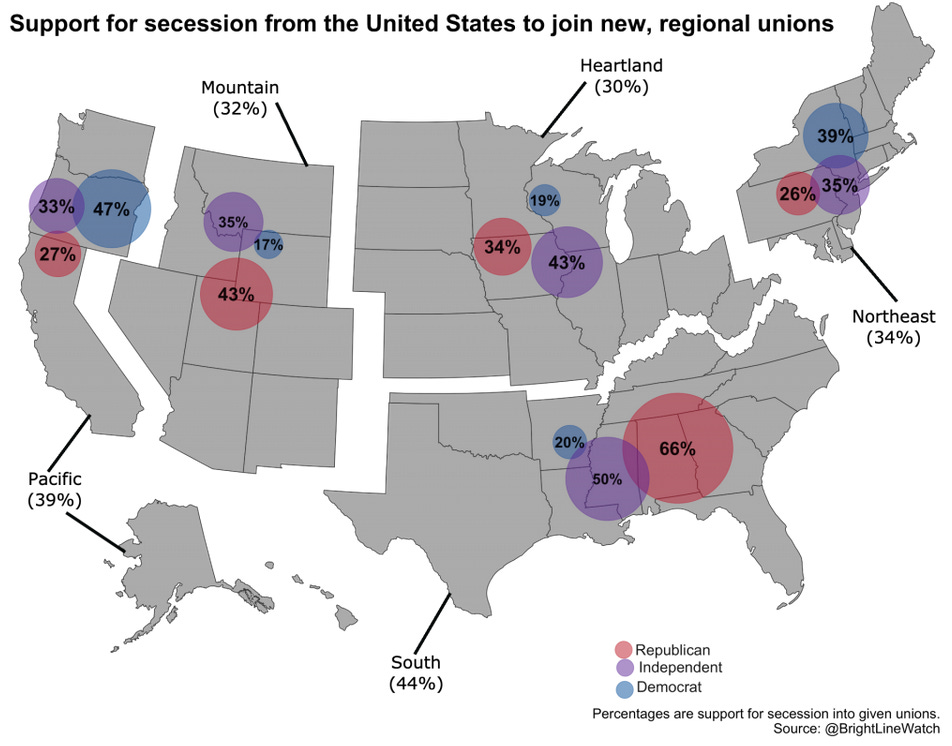
Many residents of Pacific coast states may be supportive of independence from our hostile federal government, but can’t imagine a reasonable path to getting there. For many, independence conjures images of America’s bloody Revolutionary War or the equally bloody Civil War—not an appealing prospect. But there are more modern examples of countries becoming independent through a public referendum and vote.
The example that most closely matches our circumstances here on the left coast is Quebec’s movement for independence. Though Quebec’s most recent vote for independence (1995) narrowly failed (by just 1%), the movement is still alive and may hold another referendum in 2030. In 1999, the Parliament of Canada clarified the conditions that would allow secession to occur.
I know here in the so-called “United States,” many people in the Cascadian bioregional movement would prefer any secession to occur along bioregional and watershed lines. Sadly, we currently have no legal mechanisms to allow for that. We do, however, have mechanisms for independence along state lines. And Pacific states approximate bioregional boundaries.
A first step toward independence is what Christopher Armitage has called “soft secession” and others have called “non-cooperative federalism.” That’s when state governments refuse to cooperate with a hostile federal government. Actions include enhancing financial independence from federal funds and services; prosecuting federal agents who commit crimes in state and local jurisdictions; engaging in regional, multi-state compacts; and other strategies that can be enacted at the state and local level. I’ve previously written about an independence agenda here. All Pacific states have enacted some elements of this agenda. There is more to do.
But what if soft secession is not enough? What if, for example, the current authoritarian regime manages to rig this year’s midterm elections? We know this regime is willing to lie, cheat, and steal remain in power and continue to inflict their malevolent agenda against the popular will. What if that happens in November? How should we respond? Let’s be ready.
We need to consider all our options, including full independence. That path runs through soft secession to consideration of hard secession. We need at least to put that on our menu of political options.
How does it actually happen? Potential political mechanisms are not hard to envision. State governments could put forward a referendum to their voters about if they’d prefer independence to authoritarian control from Washington, DC. If government was unwilling, it could be a citizen-based referendum.
Either way, we get to put it to a vote. Let the people decide. Like we do in democracies.
Could our Pacific states get a majority voting for something so seemingly extreme? Could anyone have predicted that the state of California would have voted to intentionally gerrymander a state that previously prided itself in non-partisan districting? It was an emergency caused by MAGA cheating, and California voters rose to the occasion. Extreme circumstances require extreme responses.
Would such votes be challenged in courts? Of course. They’d be called unconstitutional. Certain elements of the current power structure would denounce them strongly. No doubt.
But it would also be a powerful exercise in democratic imagination. It would at minimum start a political conversation in which Pacific states would have considerable leverage.
The far-right MAGA forces have constantly pushed every boundary in pursuit of total domination. Let’s not be timid in our responses. The timid will not inherit the earth.
 freelansing in Seattle
Leave a comment