
(Self-referential alert!: I mostly avoid talking about myself in this blog, which is about larger societal issues, but the passing of the print version of Eat the State!, the feisty independent paper I’ve worked on for almost 14 yrs, seemed worthy of note. Here is my personal reflection on ETS! history and my own history surrounding it.)
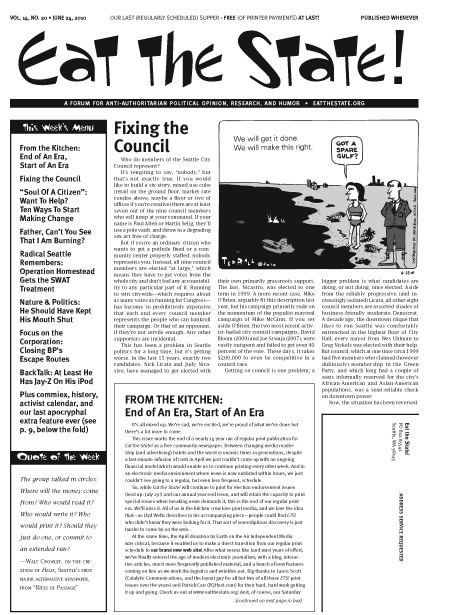 Yesterday we published the final regularly scheduled print issue of Eat the State!, the “shamelessly biased political journal” that I co-founded with Geov Parrish on Sept. 10, 1996, bringing straight-talking and incisive political commentary with a healthy dose of satire and humor to readers around Seattle and beyond. (We’ve had subscribers on five continents!) We continue publishing online at eatthestate.org, but the end of the print edition is definitely the end of an era.
What Came Before
During the 1980s & early ’90s I had worked on several independent newspapers and magazines: RAIN magazine, the Portland Alliance, the Seattle Community Catalyst, and Communities magazine. While working at the Community Catalyst, a monthly, activist newspaper I founded and published from 1990–1993, I met Geov Parrish. Originally we met at meetings for the Seattle Coalition for Peace In the Middle East, which had formed in the fall of 1990, to try to prevent the first war against Iraq by the first President Bush. Geov became a contributor to the Catalyst, and later a friend and housemate in a co-op house in Seattle’s Montlake neighborhood.
The Community Catalyst, I must say, was pretty much my life dream project made manifest. In many ways, it was based on a formula I had learned at my stint with the Portland Alliance in previous years: Create a convergence hub for activists across many issues and many philosophies to tell their stories, and for readers to discuss, discover, and get involved in making change. The Catalyst tagline was “Making connections for making change,” and we believed that in making these connections we could build a community of change-agents that could be stronger than the sum of its parts. In addition to publishing the monthly newspaper, we maintained a community resource center with a lending library and meeting space for activists.
It was a noble effort (and very important work, I still believe). We attracted many volunteers, had lots of community support, and relatively wide circulation in the community (around 10,000 papers in free street distribution plus a few hundred subscribers). But it was a constant struggle to pay the printer and keep the doors open, and after a little more than three years, we published our final issue and shut down the whole operation.
The demise of the Catalyst was a colossal disappointment for me at that time. I’d always felt that it could have been sustained if only I’d found another partner or two equally committed to the project as I was. Although a great many volunteers helped out over our history, I still personally coordinated the business end of things (such as it was), sold and coordinated our ad accounts, designed the paper and coordinated layout, did a large share of the feature writing, and did the overall editing. If only I’d found someone to take over at least one of the larger areas of coordination (business, layout, or editorial), I believed we could have sustained the project beyond its 37-month existence.
After the Catalyst, I went to work for Communities magazine, which covered the stories and lessons learned from intentional communities all around North America. It was a great gig, but I came to miss doing journalism for and about the community where I lived, the politically aware community in the Seattle area.
Launching Eat the State!
So when Geov approached me in the summer of 1996 about starting up a weekly political newsjournal, I was easily persuaded. He had the vision, had chosen a catchy and provocative name, and had worked out most of the basic concepts for it. From his introduction to our first issue (which he had written the previous year and shared with me when he first approached me):
“Welcome to this, an initial issue of what we intend to be a weekly, four-page forum for—like the masthead says—anti-authoritarian political opinion, research, news, and humor.
“While Seattle already has lots of forest-eating print publications, including some very good ones, it doesn’t have one that is explicitly anti-statist (by which we mean both governments and corporations, which these days are essentially the same); explicitly activist; or published frequently enough to respond to breaking events, decode the news, and publicize activist initiatives. … We also think being clearly biased in our approach is not only more honest than so-called “objective” corporate media, but lots more fun to read.”
Furthermore, he promised that the paper would “avoid rhetoric, make the issues of the day relevant to our daily lives, get the word out, inspire, have fun, and encourage each other to think for ourselves and look beyond what self-interested corporations and governments hand to us.”
Sounded good to me. Then of course there was the mission statement:
“Missions were used by the Spanish to colonize Mexican California in the 18th century. Their establishment was instrumental in the genocide of California’s native peoples. We oppose them.”
Though there was much to like about the project, Geov’s editorial approach was in marked contrast to my own at the Catalyst. I had been committed to focusing on how people were responding to problems rather than merely criticizing the problems themselves. I believed that critiques without solutions simply bred cynicism, so I avoided them at the Catalyst, especially critiques on national issues, which I figured were well covered by larger lefty publications. Yet Eat the State! would be primarily an extended rant against how fucked up things are. (One of my favorite magazines, Yes!, which focuses on positive actions for a better world, was also launched in 1996. I often joked that ETS! was its counterpart, and could have been called No!—or better yet, Fuck No!, since we were fond of dropping the f-bomb in print…) What redeemed it in my view was the quality of Geov’s straight-talking, vernacular writing and the healthy dose of humor he brought to otherwise serious subject matter. It was unique, it was fresh, and it was definitely worth a try.
I committed myself to being the kind of partner I wished I’d had at the Catalyst. With Geov handling all the editorial duties (he did all the writing himself for the first half year) I focused on the design and layout (and later, selecting the political cartoons, hustling advertising once we went from 8.5×11 photocopied newsletter format to tabloid offset printing, and other assorted responsibilities).
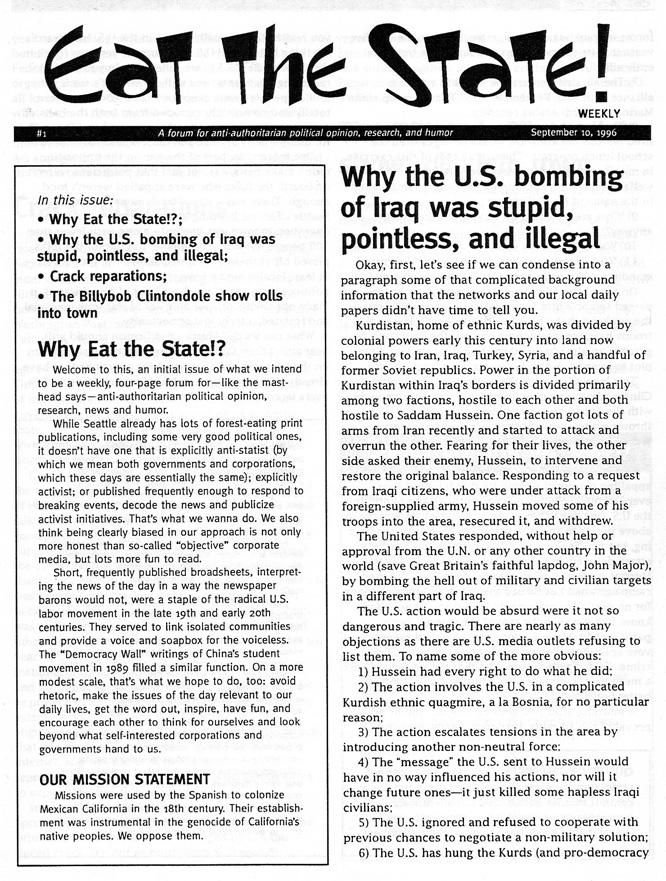
The initial release was pretty modest: four pages of two-column layout (designed for easy weekly production), no graphics, 500 photocopies distributed wherever we thought we might find interested readers. The lead headline was “Why the US bombing of Iraq was stupid, pointless, and illegal.” (Remember, this is the Clinton administration we’re talking about. Interesting how one thing the last four presidents have had in common was bombing Iraq—and how in each case it’s been “stupid, pointless, and illegal”…)
On the strength of Geov’s writing, ETS! quickly gained a following, bringing new volunteers, donors, contributors, and readers. We soon expanded the number of copies, then doubled the number of pages, then expanded to tabloid newsprint before the end of our second year. A bootstrap operation that started out with less than one full bootstrap…
One of our earliest volunteers was Eddie Tews (“ever-ready Eddie,” as I would come to think of him). Eddie is the kind of volunteer essential to the success of many grassroots organizations, who comes in, finds a niche (usually handling the grunt-work that nobody else really wants to do), and just quietly sticks with it, week after week, year after year. Most people don’t get involved in alternative publications because they want to do photocopying, assemble mailings, manage databases and bank accounts, and other organizational details. That’s what Eddie did, for more than 13 years. It’s hard to imagine Eat the State!‘s successful run without him.
Another critical piece of the puzzle came when Maria Tomchick showed up at one our weekly issue-assembly-&-mailing parties in the summer of ’97. She had previously been part of a publication on international affairs, and possessed strong and detailed knowledge about that topic and about economics. She became co-editor with Geov, and also joined him on Eat the Airwaves!, the ETS! spinoff radio show Saturday mornings on KEXP. The core team of Geov, Maria, Eddie, and I would carry ETS! through most of its 13+ years (though Maria ended her co-editor stint years ago, she remains an occasional—and ever popular—contributor to the paper, and partner in the radio show). Other long-term co-editors have included Troy Skeels early on, and Jeff Stevens, current co-editor who came on in late 2005, bringing expertise in student activism, cultural politics, and local activist history.
A multitude of other volunteers have played critical roles in the success of the paper over the years—some going to extraordinary lengths to get the paper out on the streets into people’s hands, some pulling together fundraising events that everyone agreed were necessary but no one else wanted to actually organize, and many others performing critical functions vital to a volunteer-based print publication.
In addition, we were blessed with many talented contributors donating their work to ETS!. Cartoonists have included John Jonik, Tom Tomorrow, Roberta Gregory, Ted Rall, Stephanie McMillan, Jim Siergey, and Abell Smith. Writers have included Alexander Cockburn, Robert Weissman, Steven Hill, Paul Loeb, Starhawk, and Thom Hartmann. People who make their living at their craft, donating their work to us for free simply because they believed in what we were doing.
Doing Much with Little
In many ways, it’s remarkable how much we were able to do with so little. I don’t think ETS!‘s annual budget ever topped $25,000. Although we technically had an office (always a small room shared with other activist organizations) no one actually worked there (except Eddie for a few hours a month, entering data into our one ancient computer and printing out mailing labels)—we just used it as place to drop off and pick up the papers, store some stuff, and have our meetings. Everyone just did their ETS! work in their spare time on top of day jobs. One of our editors doesn’t even have internet access at home. We’ve had little actual organization, with things continually falling through the cracks through inattention or lack of anyone wanting to deal with them. Looking back it seems a miracle that we never missed a printer deadline.
And yet… Despite its strong anti-establishment attitude, Eat the State! was being read in City Hall (including getting letters from city councilmembers defending themselves against criticisms we’d printed). Our election endorsements became very popular and carried much influence among many voters. The large corporate dailies would pick up on stories that ETS! first brought to public attention. Our activist calendar and organization directory helped a great many readers to get involved in causes they’d otherwise be unaware of. And we used to chuckle at the resumes sent to us by recently minted journalism school graduates seeking jobs—if we could fool them into thinking we were an operation with a a real office and paid employees, we must have been doing something right.
The paper also led to greater success for Geov personally. Just months launching ETS!, Geov was offered a position as political columnist at The Stranger, and later the Seattle Weekly, and became a contributor to several alternative publications. These opportunities came not because he sought them out, but because they sought him out—a situation that would be the envy of any aspiring writer. Consequently, his incisive critiques of society’s power elite found a much wider audience. The attention was well-deserved—I believe Geov is one of the best political writers I’ve read. I’ve often compared his style to the late, great Molly Ivins in his ability to distill complex issues into their essence, and deliver that essence with passion, straight talk, and humor. And despite his many scathing criticisms of many political and business leaders, he’s hardly ever written anything requiring correction or retraction. Remarkable. We can only imagine what he could accomplish if he enjoyed the same health most of us do. (Geov required a double-organ transplant just prior to ETS! start-up—in fact much of ETS! development occurred while he was convalescing from the surgery. He has lived with a severely compromised immune system ever since, leading to frequent visits to the hospital and day-to-day challenges most of us can’t imagine. I’m in awe of what he does with what he has.)
Eat the State! has been an equal-opportunity critic, skewering liberals and conservatives alike. It was started mid-way through the Clinton administration, and was particularly harsh in pointing out the abominations committed under the guise of liberalism (and I’m not talking about sex scandals, which ETS! viewed rightly as a ridiculous sideshow). Throughout the Bush administration, of course, ETS! was hardly alone in its criticisms, but again parted ways with much of the liberal media with the arrival of Obama. Yes, we’re still bombing Iraq (not to mention Afghanistan), yes, it’s still “stupid, pointless, and illegal,” yes, US government is still in the pocket of big corporations, yes, our culture is still drenched in oil despite all the warning signs… The faces and players may change, but the game remains the same. Somebody’s gotta tell that truth—it’s a vital function in any system that calls itself a democracy.
Goodbye Print, Hello Internet
It’s been a great ride, but I must confess that after 13+ years, I’m personally a little burned out on the whole print enterprise. Maintaining the print edition in the end just became too much of a struggle. A bad economy coupled with a mass migration of readers from print to the web means it’s been tough for print all over. But hey, we outlasted the Seattle P-I! Who would have predicted that in September of 1996? Not me.
Eat the State! continues our rabble-rousing online at eatthestate.org. We’ve had a website all along, but it hasn’t been upgraded in about a decade (which is like a century in internet time). Now that we’ve belatedly stumbled into the 21st century, we have all the modern conveniences—reader comments on articles, a blog that’s updated several times a week, images (previous site was text-only), colors other than black & white, type that doesn’t involve stone tablets, etc. We hope this will make for a more interactive community of readers. Come join the conversation!
PS- Now that I’ve developed some basic skills in website design and online publishing (thanks partly to helping develop the new ETS! site), I’m hoping to launch an online version of Seattle Community Catalyst sometime in the next year. You heard it here first. Let me know if you are interested in helping.


 freelansing in Seattle
Leave a reply to Larry Gales Cancel reply