Of course there is a class war, but it’s my class, the rich class, that is waging the war, and we’re winning. —Warren Buffett, third richest man in the world
A couple days after the midterm elections I wrote about reasons to get mad over the growing influence of Big Money in our elections, and a few days after that I wrote about the challenge and opportunity for progressives to mobilize a populist movement to reclaim democracy from Big Money. What are some of the key hot-button issues around which a progressive populist agenda can be built? Let’s begin at the beginning, where most populism begins…
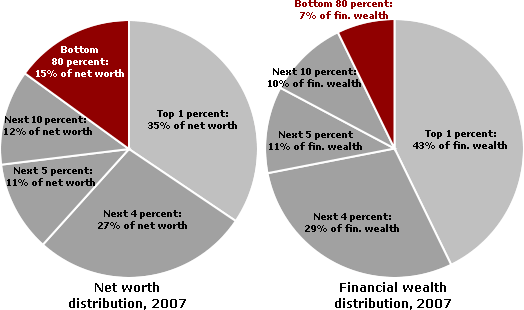
The rich got richer—Three decades of worsening economic inequality: How many Americans understand that just 1% of the population controls 35% of the wealth? Or that the the top 10% controls three-quarters of wealth overall and 83% of financial wealth?
Or that the share of national income taken by the top 1% rose from about 10% in 1980 to almost 25% today (after it had remained fairly steady for the 30 years between 1950-1980)?
Or that income had more than doubled for the bottom half of Americans between 1950-1980, then basically leveled off in the 30 years since? And meanwhile in the past three decades more than 80% of all income increases went to the richest 1%?
Or that in 1980 CEOs earned about 42 times as much as the average worker, but 531 times as much by 2001?
 We could go on & on with such appalling statistics, but they all point to the same reality: Over the past 30 years, economic welfare has remained stagnant for the majority (& declined for many) while those at the top have been making out like bandits. American wealth inequalities now exceed any time in our country’s recorded history, exceed any other industrialized nation, and put us in the ranks of the worst banana republics.
In the current great recession, while many of us are losing our jobs and losing our homes, those at the top are doing quite well, thank you, amidst a “jobless recovery.” And much of that is due to a taxpayer bailout of those at the top most responsible for the financial meltdown of 2008 through reckless pursuit of their own greed.
Which brings us to…
Banksters, Inc.—The new financial feudalism: The financial meltdown of 2008 was something of a wake-up call for many, but two years later we have not learned its lessons as a society. The new documentary “Inside Job” tells the story of the rise of financiers over the last three decades as manufacturing jobs (and the American middle class) declined. As regulations and public accountability were systematically dismantled, the financial industry ballooned into a massive casino of unchecked greed, fraud, and reckless, amoral behavior.
As Wall Street grew, so did its control of the government, so that when the whole hyperinflated system came crashing down in 2008, former Goldman Sachs CEO Henry Paulson was in place as Treasury Secretary to bail out his former Wall Street colleagues at taxpayer’s enormous expense (just before the reins were handed over to Geithner & Summers, who would continue the same Wall-St.-friendly policies in the Obama administration).
Consequently, the biggest financial heist in our lifetimes occurred in plain sight of everybody, and the primary perpetrators were allowed to walk away with their lootings largely intact, while the rest of us pay the costs. Too big to fail means too big to jail means too big, period. Wall Street owns us in more ways than one. And the term “bankster” has become more of an accurate description than quaint hyperbole.
Which brings us to looking at some of the major ways that wealth exercises power in America…
Corporate campaign donations & “Citizens United”: In January of this year, the US Supreme Court gave Big Money another gift—Citizens United vs. the Federal Election Commission, which opened the floodgates to unlimited corporate spending on independent “electioneering communications” in elections. As if large corporations didn’t already have enough political influence. Subsequently, a record $4 billion was spent on the 2010 midterm election campaigns, much of it coming from “Super-PACs” newly created in the wake of Citizens United. Not only can corporations spend as much as they want, they don’t even have to disclose these donations (this could be changed by the DISCLOSE Act currently being considered in Congress).
Big Money is becoming ever more blatant in its quest for the best government money can buy, but not without opposition. The Citizens United decision has been widely criticized, and polls show public opposition left, right, and center (80% opposed overall). A healthy majority available for aligning with a progressive populist uprising. Many citizen groups are actively opposing it, including Move to Amend, the Coffee Party, and the Backbone Campaign. These groups are planning a national action on the one-year anniversary of Citizens United, Jan. 21, 2011.
Corporate lobbying: As many American industries have been in decline, one industry that has grown greatly in recent decades is corporate lobbying. It’s no secret that Washington, DC, along with most state capitals & city halls, have become “corporate-occupied territory” (e.g., see “Who Owns Congress?” for a federal breakdown). The lobbying industry has more than doubled in the last decade. Health-related lobbying alone accounted for over $500 million of spending during 2009. These lobbyists not only excluded single-payer advocates from the discussion, but successfully prevented a public option. Fossil-fuel lobbyists prevent progress on addressing the climate crisis. Financial lobbyists prevent meaningful reform of their industry. And on and on down the line.
Few regular citizens approve of the corporate takeover of government, but many get confused by political and media talk of “special interests” that seems to equate the “special interests” of private money with the “special” (read: public) interests of social justice & environmental nonprofits and labor unions. Most understand that something smells bad here, but the details remain unclear and the outlets for constructive action even less clear.
Why are these details unclear? Isn’t it the job of the media to clarify important public matters like this? Yes, but…
Big money & big media: Just as financial deregulation enabled growing concentrations of financial wealth, media deregulation has enabled growing concentrations in media, consolidating ownership in the hands of the same type of wealthy, corporate interests we have been discussing here. America’s founders conceived of the media/”free press” as an essential component of democratic governance, the conduit by which citizens would gain the essential public information necessary to make political choices and implement government “of the people, by the people, and for the people”—but it’s clear that modern media moguls lack such noble ambitions and instead see the media as just another profitable investment.
With the rise of FOX “News”—a full-time political operation disguised as news media, seemingly designed to trick its viewers into siding with private interests against public interests—the mainstream corporate media has become even more vacuous and pursuant of ratings-boosting “controversies” (often contrived by right-wing sources) and superficial horse-race politics over any substantive coverage of issues that matter. And is it surprising that we rarely hear anything about the central issues discussed here—who wields power and how—from media organs owned by power-wielders?
Perversely and fittingly, as political campaign spending increases, major media outlets are among the primary beneficiaries as they incessantly bombard us with political advertising. Closing the circle, so to speak.
Fortunately, as media is concentrating at the top, it is diversifying at the bottom, thanks largely to the universal access enabled by the internet. People who want news outside the corporate consensus have a growing array of options, including community-based sources like Democracy Now!, the Real News Network, GRITtv, Huffington Post, and others, as well a few larger network sources like MSNBC, the Daily Show, the Colbert Report, & Bill Maher (the latter three delivering more insight and important information in their “entertainment” format than does most “serious news” of major media).
And what does this all add up to? Robert Reich has called it a “perfect storm“:
An unprecedented concentration of income and wealth at the top; a record amount of secret money flooding our democracy; and a public becoming increasingly angry and cynical about a government that’s raising its taxes, reducing its services, and unable to get it back to work.
We’re losing our democracy to a different system. It’s called plutocracy.
Plutocracy—now there’s a word that needs to be spoken much more often in contemporary political discourse. Or, as Warren Buffet so cogently put it, it’s “class war,” and the class he belongs to is kicking some serious ass these days. The question is: When will the majority of us whose asses are getting kicked start fighting back? Like, for real.
By now it should be clear that the Democratic Party isn’t going to help us. Barack Obama isn’t going to help us. Even much of the public-interest nonprofit infrastructure developed over the last four decades or so seems poorly equipped to help us (as many groups have become increasingly intertwined with wealthy corporate benefactors). But as I’ve tried to note in this essay (esp. the links), lots of people are paying attention and many offer valuable resources. And some have begun organize around these hot-button issues, but more heat is needed.
And more leadership, I think, to bring to the fore this constellation of fundamental issues about who really runs this country, and to organize a majoritarian coalition in favor of government by & for the people instead of by & for the big corporations and wealthy elites. We need to talk less about left vs. right and talk more about bottom vs. top.
Because that’s how we win, it seems to me. Public opinion surveys already show that strong majorities—across the political & economic spectrum—do not approve of the current distribution of wealth, or with the Citizens United decision, or other distortions of the public sphere discussed here. The sentiments are already there, but the leadership needs to be stronger.
And because, unless we win this contest, we don’t win any of the other issues we care about—social justice, environmental, peace, whatever… As long as wealth & power rule, anything that doesn’t serve wealth & power loses. Of course, this has always been the case to greater or lesser degree throughout history, but as wealth’s grip on power tightens amid our current perfect storm, we can no longer ignore it.
As people continue to lose their homes, lose their jobs, lose their public services, and look for who’s responsible for this breakdown in the system, disillusionment and anger grows. Where will that energy be directed? So far, the Tea Party is capturing much of that disgruntlement, and misdirecting it against all the wrong targets. But as new conservative leadership seeks to retain tax cuts for the rich while cutting benefits for unemployment, Social Security, and Medicare, the conservative illusion will be harder to sustain.
As progressives, reality is on our side. Numbers are on our side. As Pogo said, “We are confronted with insurmountable opportunities.”
Let’s get busy.
(I’d love to hear a wider discussion about these matters, so please share any thoughts, critiques, resources, etc. in the comments section.)


 freelansing in Seattle
Leave a reply to Bad blogger! Good uprising! Catching up on a year’s worth of events « freelansing in Seattle Cancel reply